Customer obsession is a margin strategy
Most enterprises accidentally ship their org chart—every silo fighting for the customer’s screen.
Pin the 30% promo above the fold.
Re-verify SMS and billing first.
Open the card offer on launch.
Sign in again every 15 minutes.
Answer with help articles.
Every squad ships its own button.
AI assembles the bag
WebMCP · 200 OK · 38 ms
promo_stack → −$42
AI stages the math. Humans hold the gate.
tok_forge_bnpl → $187.00 × 4




Sign in again to see your order.
Sign inCompounding P&L Lift
Among the results: $60M in retail media revenue and +200% mobile conversion.
Service Line Velocity
Customer wait times cut across a 60-location pilot via digital check‑in.
Platform Adoption Reset
Monthly active advisors (against a goal of 100) after resetting a $70M enterprise platform.
Cycle-Time Compression
Regulatory document delivery rebuilt end to end; a $27M program redirected on research.
01—The mandate
Strategy dies in the gap between what the board decides and what the team ships on Monday.
I live in that gap. I turn boardroom ambition into products, systems, and code we actually ship—doing the work alongside the team and making sure what we learn from customers reshapes the next bet.
Low ego. High standards. High throughput.
Squads where Business, Product, Design, and Engineering own one shared outcome—paired with two career tracks and standards nobody has to be reminded of.
Focus is a decision.
Rebuilding how a company decides what to build—naming the target, and naming everything we’re deliberately not doing, so teams don’t lose to their own unfinished list.
Insight is only useful when it moves the P&L.
Owning the roadmap and the commercial number attached to it without spending customer trust.
One shared reality.
One sanitized, consent-aware view of the customer across 75+ systems, so every line of business serves, keeps, and grows the same person.
Out of the ticket queue.
Moving design and research into the room where capital allocation and product bets are made.
Inside the workflow, not beside it.
In the product, AI reads customer intent and routes them; in delivery, governed design systems ship straight to repository code.
No one likes jerks.
Brilliance doesn’t grant permission for bad behavior. I run a “best idea wins” room where we debate hard, decide, and commit—my ego is tied to the scoreboard, not the spotlight.
It starts with the spreadsheet, not the sketch
Five steps, in this order. Nothing gets designed before we know what the friction costs the customer and the business, and nothing ships before the operational reality behind it has been proven.
Strategy is not just planning; it is choosing what not to do.
I align cross-functional leadership on a single, high-value destination, so every effort from discovery through delivery builds the competitive advantage of the future rather than only fixing a current pain point.
Data turns opinions into business cases.
I analyze operational data to pinpoint where friction is creating measurable financial drag and size the opportunity first, so the team prioritizes by impact on the P&L, not by anecdote.
A digital promise requires an operational guarantee.
I design the whole service, not only the interface. Every promise made to the customer on the front stage is matched by a viable, scalable workflow on the back stage.
Viability must precede velocity.
In complex, regulated environments, I stress-test the business logic, governance, and technical feasibility early, so we de-risk the solution before development begins rather than paying for a rebuild later.
True success is a balanced equation.
I measure business impact, customer experience, and employee experience together. A product succeeds only if it delivers to the P&L without transferring friction to the customer, the partner, or the employee.
↻What each step proves sets up the next vision.
Strategy is choosing what not to build: two requests declined, one bet funded.
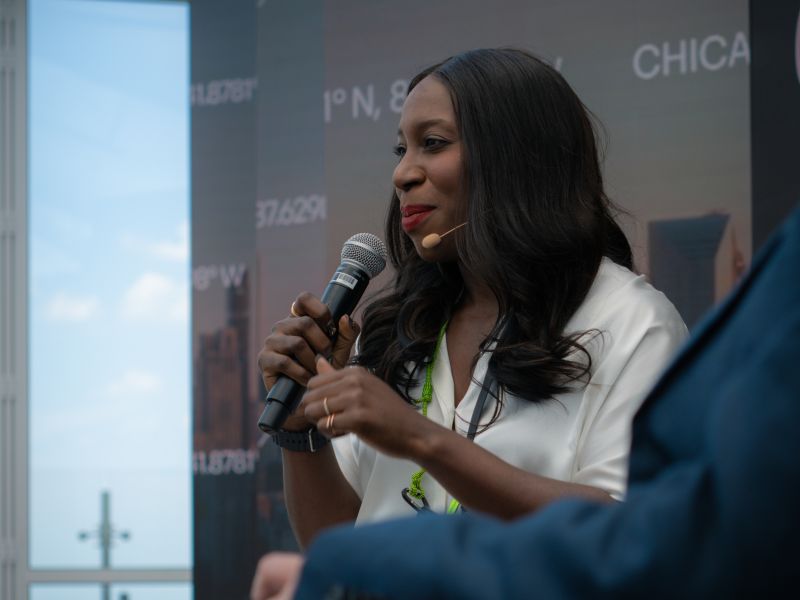
o9 Solutions, in partnership with Bain & Company
What does it mean to become a customer-centric organization?
“Transformation can’t happen when it’s only external and outward-facing. You have to think about everything that must change to be customer-centric.”Read the summit recap
Selected work, shared privately.
The detailed case studies—the P&L turnarounds, shipped interfaces, and unfiltered lessons—live behind a passphrase. Enter yours below, or ask and I’ll share access directly.
The private portfolio uses cookies and analytics, including session recording and AI-written summaries, to understand how it is used. Nothing you type is recorded. Don’t record me